Data Ethics and Responsible AI
The whole structure of 12 Angry Men is one juror refusing to vote guilty quickly because a man's life is on the line and the evidence deserves more than the room is giving it. The room is impatient. The evidence looks clean. The juror keeps asking questions anyway. That's the posture responsible AI work demands and almost never gets, because the evidence always looks clean and the room is always impatient and the costs of slowing down to ask are always paid by someone whose face nobody in the room has seen.
I want to write about AI ethics in a way that doesn't sound like AI ethics writing, because most AI ethics writing is the problem it's trying to describe. Abstract principles. Categorical lists of risks. Frameworks that nobody actually applies because they were written for the conference, not the standup. The honest version of the topic is smaller, harder, and less satisfying to publish. So let me try anyway.
The first thing to say is that ethics in AI is not a separate discipline. It's not a thing you bolt on after the model works. It's the set of decisions you make at every stage, most of which look like engineering decisions or business decisions and only reveal themselves as ethical decisions later, after the harm has already happened to someone. Which dataset you train on. Which features you include. Which threshold you set for the classifier. Which fallback you write for the cases the model handles badly. Which observability you build. Which user gets served by the cheap version of the system and which gets the careful one. None of these feel like ethics in the moment. All of them are.
The second thing to say is that most production AI systems are doing things their designers didn't quite intend. Not because the designers were careless. Because the gap between what a model is trained to do and what a model ends up doing in the wild is structural, and most teams don't have the observability to see what their systems are actually doing. A loan model trained on five years of historical decisions inherits five years of historical bias. A hiring screen trained on past hires reproduces the patterns of past hiring. A risk model deployed at scale starts shaping the world it was supposed to be measuring. None of these are bugs. They're the model doing exactly what it was trained to do, in a context where the training assumptions no longer hold. The ethical work is recognizing this and building for it.
I'll give a concrete example, anonymized. A team I worked with built a customer-routing model that decided which support requests went to a senior agent versus a junior one. The metric was efficiency. The model worked. Several months in, somebody noticed that the model was systematically routing requests from certain ZIP codes to junior agents, and certain other ZIP codes to senior agents, in a way that mapped almost perfectly onto income demographics. The team hadn't included income or ZIP as features. The model had inferred the pattern from a hundred other features that correlated with it. The fix was not the model. The fix was the team admitting that "efficiency" had been doing moral work that nobody had named, and the metric had to change. That's the actual shape of AI ethics work. Not the framework. The conversation in the room when the team realizes what the model has been quietly optimizing for.
The third thing to say is that the bureaucratization of AI ethics has made it harder, not easier, to do the work. Most large companies now have AI ethics committees, principles documents, review processes, compliance checklists. The output of all this machinery is, in most cases, a paper trail that proves the company considered the ethics. It is rarely a system that actually behaves ethically, because the people running the machinery are not the people building the model, and the people building the model are not rewarded for slowing down to engage with the machinery. The juror who pauses the room costs the room time. The room resents him. The same dynamic plays out in every AI project where the ethics function is downstream of the build.
The fourth thing, and the harder one, is that responsibility in AI systems gets diffused across so many hands that no single hand feels responsible. The model was trained by a vendor. The data was collected by a third party. The deployment was decided by product. The threshold was set by ops. The user interface was built by frontend. The customer who got hurt by the decision is talking to a support agent who doesn't know any of this. Each hand can honestly say it didn't make the harmful decision. The harm happens anyway. The ethical structure most teams need is not more frameworks. It's a person whose job is end-to-end accountability for what the system actually does, with authority to stop it. Almost no organizations have this role. The ones that do tend to have systems that go wrong less often.
A few patterns I've come to believe:
- Build evaluation that catches the cases that matter, not the cases that are easy to test. Most AI evaluation suites measure aggregate performance on a held-out test set. The ethical failures live in the long tail, in subgroups too small to move the aggregate metric, in edge cases the test set didn't represent. Catching these requires deliberately building evaluation against demographic slices, against worst-case examples, against the populations most likely to be harmed. Nobody will thank you for doing this. The model will look slightly worse on paper. The system will be substantially better in reality.
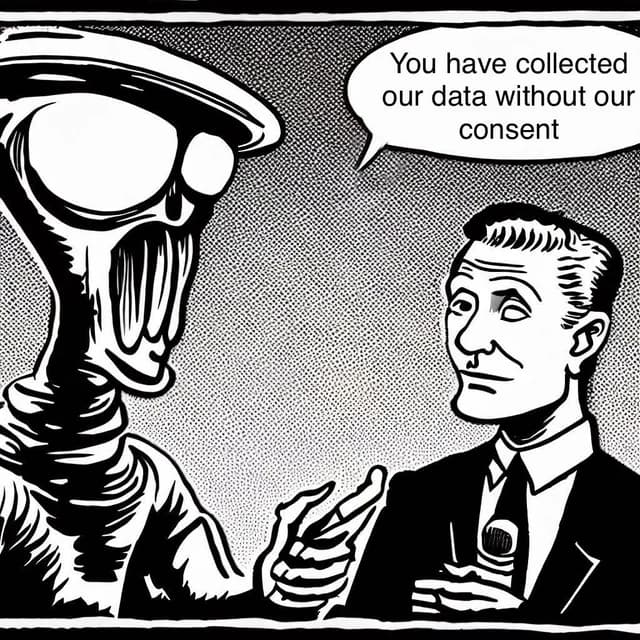
- Treat consent and disclosure as design requirements, not legal requirements. The legal version of consent is a checkbox. The ethical version is whether the user actually understands what's happening to their data and what the system is going to do with it. Most products fail this test catastrophically and get away with it because the legal version is what regulators check. The teams that take the ethical version seriously build different products. They lose some short-term metrics. They build durable trust.
- When in doubt, slow down. The juror in 12 Angry Men does not present new evidence. He presents a willingness to take longer. That willingness is the entire intervention. Most AI harm in production happens at deployment velocity, when the team is shipping fast and the cases that would have triggered concern get noticed only in retrospect. The ethical move, when something feels off, is almost always to delay the ship, look harder at the failure modes, and wait for a clearer picture. Teams that can't do this don't have ethics. They have a deployment pipeline.
- Document what the system does, not what you intended it to do. The intent gets recorded in the original spec. The actual behavior is what the user experiences, and the gap between the two is where the moral problems live. Honest documentation says "the model behaves this way in these cases, including these failure modes we know about and have not yet fixed." Most documentation says "the model is designed to behave this way," which is true and unhelpful. The user does not interact with the design. The user interacts with the behavior.
- Ask whose face is missing from the room. Most ethics conversations about AI systems happen among the people who built and deployed them. The people on the receiving end of the decisions are usually not represented. Sometimes they can't be. Sometimes they could be and aren't because nobody thought to invite them. The ethical posture is to keep asking the question, even when the answer is that you can't fix it this round. The asking changes how the room thinks. The not-asking lets the room forget there's a face on the other side at all.
The deeper thing about AI ethics is that it is not a technical problem with a technical solution. It is a question about what we owe the people downstream of our work, and the answer requires moral seriousness that the field is mostly not practicing. The engineering can be sophisticated. The moral seriousness is what's missing. Until that changes, the principles documents will keep getting longer and the harms will keep happening at the same rate, because nobody has actually slowed the room down.
Wendell Berry has written for fifty years that the test of any technology is what it does to the community that uses it, not what it does in the abstract. The frameworks fail this test by skipping the community. The principles fail this test by speaking only to the technology. The teams that pass this test are the ones who keep asking, in every meeting, what their system is doing to the people on the receiving end of its decisions, and who slow the room down when the answer isn't good enough. That's not a framework. That's a discipline. It's the only one that matters.